Secure IoT lifecycle management

From device to managed fleet.

The RIoT Secure platform links constrained devices to the systems that manage them. It brings together device identity, encrypted communication, firmware delivery and fleet operations, with clear boundaries between the application and its lifecycle infrastructure.

Clear boundaries. Independent responsibilities.
Application MCU Your application Device behaviour and local processing
Communication & security MCU Secure lifecycle layer Connectivity, identity and software delivery
Fleet management & integration

One system. Two sides of the lifecycle.

On the device, the RIoT Secure client handles platform communication and lifecycle operations. In a Fusion configuration, that client runs on a communication and security MCU, separate from the MCU executing the customer application.

On the backend, Oasis manages device identities, software versions and fleet operations. Its REST API connects lifecycle functionality to existing dashboards and business systems. The application, communication layer and backend each have a defined responsibility.

Choose the right execution boundary.

Fusion separates application execution from communication and security across dedicated microcontrollers. Application developers keep their own toolchain and programming model, while the RIoT Secure client handles the connection to the lifecycle platform.

Brawl provides a WebAssembly execution environment for portable application logic. Its software sandbox and Fusion’s physical separation provide different forms of isolation. The execution model and hardware configuration should be chosen together for the application.

Keep software delivery inside the lifecycle.

The RIoT Secure platform provides over-the-air firmware delivery so deployed devices can be updated without routine physical access. Oasis supplies the management layer, while the embedded client handles communication with the device.

Native firmware and WebAssembly applications have different delivery and execution requirements. Brawl provides the runtime for supported WebAssembly modules; the hardware configuration and application architecture determine how each software layer is deployed and updated.

Five components. Defined responsibilities.

The platform combines communication, hardware separation, fleet management and application execution. Each component has a specific role; the architecture is assembled around the device and its operational requirements.

01

µTLS

Protected communication

µTLS is the communication layer between devices and the RIoT Secure backend. It combines encrypted communication with efficient data encoding for constrained environments. It supports device data exchange and the delivery of lifecycle commands and software, while working over the selected underlying transport.
02

Fusion

Hardware separation

Fusion places the customer application on a dedicated microcontroller, separate from the communication and security MCU running the RIoT Secure client. Application developers retain their own firmware, peripherals and development tools, with an interface to the communication and lifecycle layer.

03

Oasis

Fleet management + integration

Oasis is the platform’s fleet management and integration layer. It provides a management interface and REST API for device identities, software versions and lifecycle operations. Organisations can use its console or integrate those functions into their own operational tools.

04

Brawl

WebAssembly execution

Brawl provides a WebAssembly runtime for constrained devices. It gives application logic a portable execution format, with bindings for supported device functions. Modules operate within the runtime and can be managed through the surrounding lifecycle platform; native firmware remains a separate execution choice.

05

Shield

Application protection

Shield adds a protection layer for WebAssembly applications used with Brawl. It addresses application logic and intellectual property on the device, alongside the platform’s communication and lifecycle mechanisms. Its protection scope depends on the supported runtime and device configuration.

Fits into the system you already operate.

RIoT Secure complements existing networks, cloud services and application platforms. The underlying network still provides connectivity; µTLS adds the device-to-backend communication layer, and Oasis supplies lifecycle management through its console and REST API.

An integrator can use the management interface directly or connect lifecycle functions to an existing customer experience. Application logic, operational analytics and business workflows remain with the systems responsible for them.

Hardware built around your application.

Start with the architecture.

The RIoT Secure platform is delivered as a Platform as a Service, with an embedded client on the device. Development boards and reference hardware can provide a starting point, while the application and lifecycle boundary guides the choice of processors, communication modules and interfaces.

Adapt the board to the deployment.

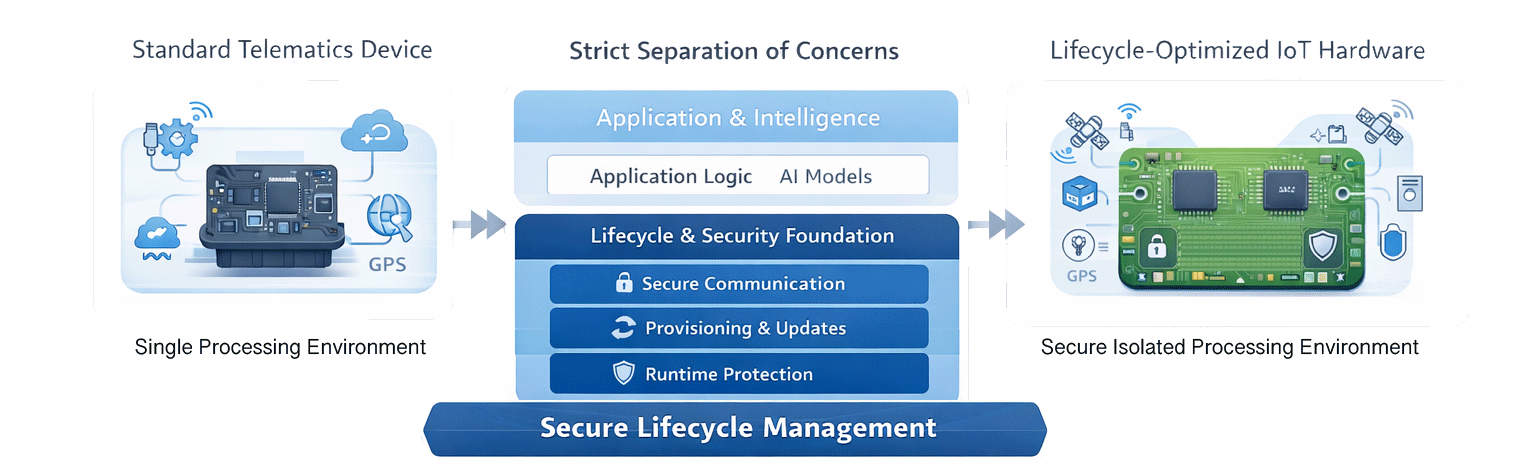
RIoT Secure has designed custom PCBs when a deployment required a different hardware arrangement. This allows communication modules, GNSS and sensor interfaces to be selected for the operating environment while retaining the separation between application processing and communication or lifecycle functions.

Diagram showing application processing separated from the communication, security and lifecycle layer, and its implementation in custom IoT hardware
A lifecycle-first hardware architecture · View full-size diagram

See how the platform fits together.

Watch the explainer for an introduction to the device architecture, communication layer and lifecycle management approach.

Map the platform to your device.

Discuss your application hardware, connectivity, software delivery and fleet integration requirements with the RIoT Secure team.