

Until now, RIoT Secure has made a very deliberate choice: built and keep everything in-house.
That was not because we did not believe in openness, collaboration, or ecosystem thinking. It was because we believed that before anything else, we had to validate the foundation. When you are building in embedded security, lifecycle management, constrained systems, and edge intelligence, the architecture has to be real. It has to work in the field. It has to prove itself over time.
That is what we have focused on.
We have now seen that validation in practice. Our five-year deployment with Scandinavian Airlines has been a major proof point for us, showing that our approach can hold up in a real operational environment. Alongside that, we have also explored edge AI integration through pilots and use cases such as our work with Comau and indoor/outdoor detection together with Neuton.ai, now part of Nordic Semiconductor (for more information on these projects visit: AI @ EDGE).
These experiences have reinforced something we believe more strongly than ever:
The future is not just secure communication.
The future is secure edge and AI lifecycle management.
Connected devices are no longer static endpoints. They are becoming dynamic, programmable, updateable, intelligent and systems that need to be managed over years. Firmware is only part of the lifecycle now. The management of models, policies, trust, identity, and execution environments are becoming just as important.
That is the direction we are building toward.
At the same time, we have learned an important commercial lesson. Even when people understand and appreciate the architecture, adoption slows down when the platform feels too dependent on the vendor behind it. Developers want freedom to explore. Integrators want flexibility. Enterprises want control over how and where things run.
We believe the next step for RIoT Secure is clear - move our platform in a more open direction.
Our intention is to make key backend and integration components available for self-hosted use, including the IoT server, REST API, management console, and standard integration points. The goal is simple: reduce adoption friction, remove unnecessary service dependency, and make it easier for developers and organizations to engage with RIoT Secure on their own terms.
This is not about dumping code and hoping for the best. It is about creating a deliberate and credible boundary between a genuinely useful community offering and an enterprise-grade platform.
How we see Community and Enterprise
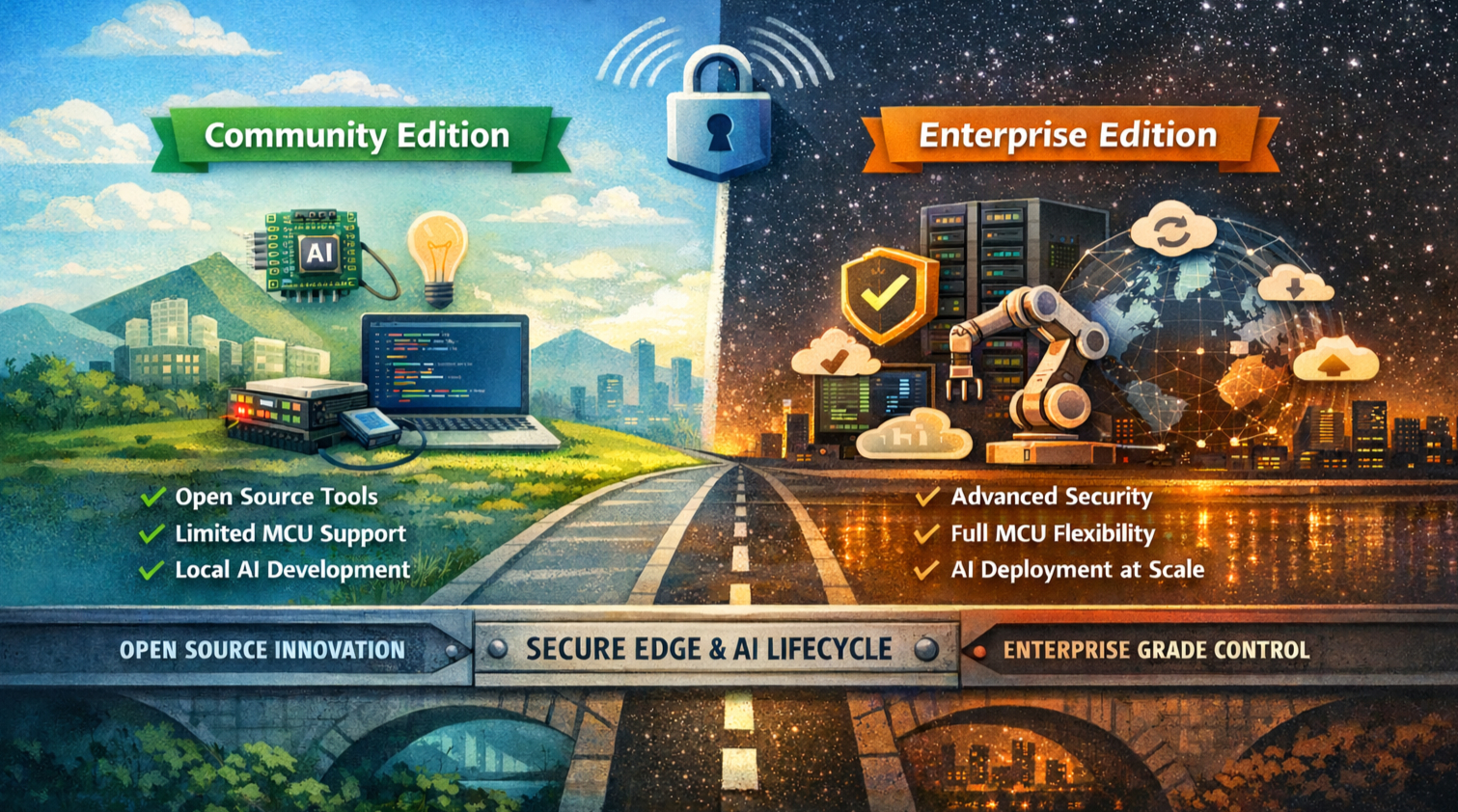
We want the Community Edition to be real. Not crippled. Not symbolic. Real.
The Community Edition should be useful for learning, experimentation, prototyping, self-hosted evaluation, and early development. It should help developers understand the platform, work with it locally or in their own environment, and build on a curated and accessible foundation.
The Enterprise Edition has to be clear extension of the Community Edition yet different and the distinction should be obvious, value-add, architectural, and commercially meaningful.
Community Edition
Designed for developers, makers, education, self-hosted evaluation, and early-stage prototyping.
Expected focus areas include:
- self-hosted backend deployment
- IoT server, REST API, management console, and standard integrations
- curated support for a subset of developer-friendly microcontrollers
- standard provisioning and lifecycle flows
- personal, educational, and prototype use
- edge experimentation, including AI-enabled use cases
Enterprise Edition
Designed for commercial products, production fleets, and organizations that need governance, flexibility, and operation at scale.
Expected focus areas include:
- broader hardware freedom and enterprise deployment flexibility
- advanced lifecycle management
- multi-tenancy
- policy-based control
- secure element and root-of-trust integration
- governance and auditability
- differential firmware updates
- independent AI model lifecycle management
- production-scale operational capabilities
That distinction is intentional.
We do not want to prevent developers from building AI-enabled edge solutions. Quite the opposite. But there is a real difference between enabling experimentation and delivering production-grade lifecycle control for firmware, models, trust, and policies across fleets and organizations.
That is where enterprise value should be obvious.
It is also important to say clearly that our core IP remains in the embedded domain. Our strongest differentiation is in the microcontroller environment: microTLS, our patented communications protocol, embedded trust, lifecycle handling in constrained systems, and the WebAssembly direction we are pursuing at the edge. That is the heart of RIoT Secure, and it will remain so.
Why we are sharing this now
Because waiting until every detail is finalized may be the wrong move.
We have been a closed company by design, and open source is new territory for parts of our team. But the right answer is not to stay silent until everything is perfect. The right answer is to start the conversation now, with clarity about where we are heading and why.
As a 100% founder-owned company, we have always been disciplined about building substance before scale. We have had investor conversations before, but customer adoption has often been the sticking point. Not because the technology was not strong, but because adoption friction was too high.
We believe this next chapter can change that.
A self-hosted community foundation creates a broader entry point. It gives developers something real to work with. It gives enterprises more confidence. It creates a path from technical interest to production deployment. And it may also create a stronger foundation for the kind of investment that can help accelerate this transition.
We are not changing because the foundation was weak.
We are changing because the foundation is now strong enough to support broader adoption.
We would like to hear from you
We are sharing this now because we want feedback, interest, and conversation. If you are a developer, embedded engineer, partner, customer, or investor interested in where RIoT Secure is going, we would genuinely like to hear from you.
We are especially interested in hearing:
- which microcontrollers and developer boards should be part of an initial community support matrix
- what would make a self-hosted community edition genuinely useful
- which enterprise capabilities are essential for real-world production deployments
- how you think about firmware, AI model, policy, and trust lifecycle management at the edge
This is the next chapter for RIoT Secure: from closed validation to broader adoption, from secure communication to secure edge and AI lifecycle management, and from a tightly controlled foundation to a platform that more people can explore, trust, and build on.
We are excited about what comes next.
We would be glad to hear from anyone who wants to follow, contribute to, partner with, or invest in that journey.
 From Interns to Innovators: Exploring Local AI at RIoT Secure